Saturday, 23 March 2013

The genius of Lutosławski

Witold Lutosławski

The Philharmonia’s Woven Words series, celebrating the centenary of Polish composer Witold Lutosławski, came to an end on Thursday with a concert that included the haunting nocturnal orchestral song Les espaces du sommeil and the ferocious Fourth Symphony:

“Even without its concentrated and compelling narrative of mounting violence, Lutosławski’s Fourth would be remarkable for the sounds it conjures: rippling harp motifs, impossibly rich string textures and molten brassy climaxes. But it grips with its anguished momentum, seeming surprisingly close to the stark and enigmatic concerns of Shostakovich more brutalised symphonies. Its pull was only strengthened by the Philharmonia’s effortless and dazzlingly colourful playing and the force of Salonen’s no-holds-barred conducting. How can this remarkable symphony be such a concert hall rarity?”

Friday, 15 March 2013

Dudamel and Adams bring their Green Umbrella to London

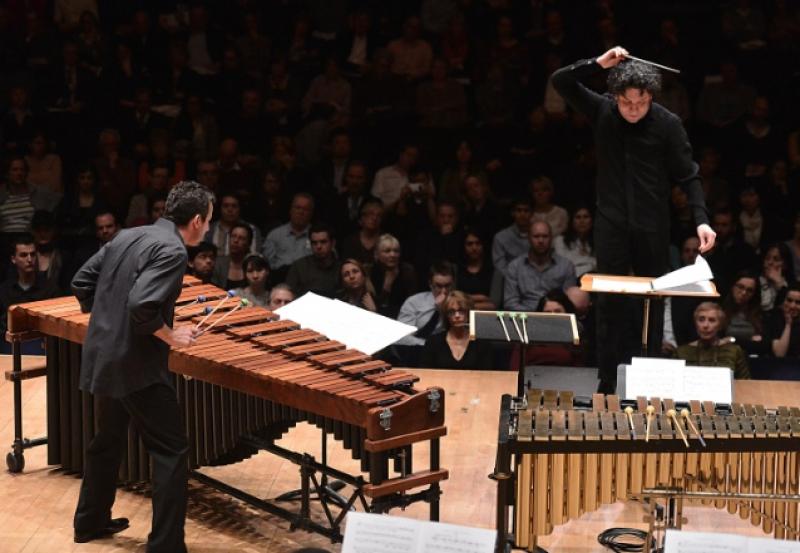
Joseph Perira and Gustavo Dudamel (photo: Mark Allan for the Barbican)
Perhaps the unfamiliarity of the first programme of the Los Angeles Philharmonic’s three night Barbican residency was too much for some – even with the world’s hottest conducting property on the podium, there were auditorium seats to spare – but in scheduling quite so much new music, the LA musicians and their music director Gustavo Dudamel demonstrated the kind of bravery few other world-class orchestras posses. This was a taste of the LA Phil’s Green Umbrella series of concerts, dedicated to new music and headed by John Adams. The orchestra’s New Music Group tackled three widely contrasting works with terrific assurance, bringing chilly London a tantalising slice of LA’s new music scene.

The programme featured music by Adams, the LA Phil principal timpanist Joseph Pereira and Korean composer Unsuk Chin. You can read my full review at Classical Source.

Wednesday, 13 March 2013

Alexander Kniazev plays Franck and Ysaye


Franck & Ysaÿe: Music for Cello and Piano
Alexander Kniazev (cello)
Plamena Mangova (piano)

Fuga Libera FUG587


The notes for Alexander Kniazev’s disc of borrowed music open with an incomprehensible justification for the practice of transcription. In truth, no argument is necessary: if these musicians wish to take music written for violin and play it on the cello, they are welcome. In practice, some transfer better than others, as demonstrated by this recital.


Kniazev is far from the first cellist to play César Franck’s evergreen Violin Sonata and, as a transcription, it works well. The long lyrical lines of the Sonata, composed for the young Eugène Ysaÿe in 1886, are rendered well on Kniazev’s instrument and there isn’t too much rapid fingerwork to get caught up in. Kniazev’s performance slows the opening Allegretto to a grandiose showcase of his remarkable sound, a torrent of extraordinarily rich legato tone redolent of the Oistrakh and Rostropovich. It really is something to behold - whenever the Sonata obliges, Kniazev opens the taps and that sound comes out. It results, however, in a monolithic performance, basking in the glory of these edifices but revealing disappointingly little of the music’s drama and narrative. Pianist Plamena Mangova often has to make do with unsympathetic tempos which disrupt the flow of Franck’s keyboard writing.

Franck’s song Nocturne of 1884 is successful without the words, but two pieces by Ysaÿe reveal the more problematic aspect of transcription. Both the Berceuse and the Poème élégiaque were composed for violin and orchestra, though both are more commonly encountered in versions for violin and piano. Ysaÿe’s often virtuosic writing pulls Kniazev away from his comfort zone and, in all honesty, the transcriptions sound uncomfortable. In addition, Ysaÿe music was often specifically composed around the possibilities of his own instrument. A funereal episode in the Poème élégiaque is a case in point: Ysaÿe asks the violin to detune the bottom string by a whole tone, producing an unexpected and unusually deep sound. This section lies well within the reach of the cello, and the effect is lost.

The disc is very clearly recorded, somewhat to the detriment of the impressionistic Berceuse. While I’ve no problem with musicians looking further afield for repertoire, I really wonder why Kniazev and Mangova chose to record two of Ysaÿe’s violin works, when both his Sérénade and Méditation for cello and piano have (to the best of a my knowledge) never been recorded. Then there’s a darkly intense Sonata for Solo Cello, which Kniazev might have excelled in. Maybe next time?

Wednesday, 6 March 2013

Steve Reich's Radio Rewrite

Steve Reich
Few contemporary composers draw the kind of crowds that Steve Reich does, and his appearance with the London Sinfonietta yesterday at London’s Royal Festival Hall had been sold-out months ago. Tickets were so scarce that press comps couldn’t eventually be offered to those towards the bottom of the food chain (i.e. me), but the disappointment was quelled by Radio 3’s live broadcast, fronted by a clearly-excited Andrew MacGregor.

It began (as Reich concerts often do) with the composer’s 1972 piece Clapping Music, intended as a demonstration of music without conventional instruments. Reich took one of the two parts for last night’s performance of this early example of his ‘phase’ pieces. Another classic followed, with Mats Bergström dusting off Reich 1987 work Electric Counterpoint, originally written for jazz guitarist Pat Metheny and consisting of overlaid tracks and a final part played live. In performance, I’ve found it an odd spectacle – one live musician playing one of twelve parts, seeming a little karaoke – but it works well on the radio, where the whole blends seamlessly with no visual distractions. It remains one of Reich’s loveliest creations.

A clutch of more recent pieces formed the bulk of the programme. 2x5 (2008) makes use of instruments more often associated with rock music – electric guitars, basses, drum kit – and marks a departure from Reich’s more conventional instrumental palette. It chugs along in typically Reichian fashion, but the twang of the guitars lends an unexpectedly homemade feel that becomes quite endearing. The headline work of the night was the premiere performance of Radio Rewrite, based in part of two songs by Radiohead (“Jigsaw Falling into Place” and “Everything in its Right Place”). The songs are barely recognisable, having been subsumed into Reich’s familiar language, but something of Radiohead’s distinctive harmony has clearly rubbed off, particularly in the slower sections. Finally, his Pulitzer Prize-winning Double Sextet (2007) demonstrated his work for an unusually large combination of instruments, but couldn’t quell the feeling that too much of Reich’s music is cut from the same cloth.

Friday, 1 March 2013

Baltic Nights with Britten Sinfonia

Alina Ibragimova (Photo: Sussie Ahlburg)

 
“Pēteris Vasks’s Violin Concerto “Distant Light” presses the button marked “spiritual angst” quite effectively, but for all its sincerity, feels hamstrung by the chunkiness of its transitions. Alina Ibragimova gave it the very best performance its composer can possibly have wished for (he was present and looked very pleased), directing the ensemble of strings while burrowing deep into its heartfelt expressive core with an unyielding intensity that marks her out as one of the world’s most powerfully persuasive violinists. It brought a large part of the audience to its feet but left me only intermittently touched. Ultimately, I’m unable to shake the feeling that Arvo Pärt does this sort of thing better.”

Wednesday, 20 February 2013

Great opera, apparently


Charpentier's opera Medea - given in a new production by David McVicar at English National Opera - has prompted the usual range of reactions from reviewers: largely appreciative of the opportunity to see this baroque opera; more mixed on the virtues of the production. One reaction found in ENO’s review-quote-stuffed post-first-night promotional email, however, caught my eye. A comment, taken from Facebook and appearing alongside reviews from The Times, The Gaurdian and The Arts Desk, says:

'Can't wait to see it next week. 5* reviews for 'Medea' are fantastic.'
 
While I do look forward to further second-hand recommendations, I do worry that they might not be heard above the sound of the scraping of the bottom of the social-media barrel.       

Thursday, 14 February 2013

Janine Jansen directs Mozart and Bartok

Janine Jansen

"Marking the conclusion of a tour of 8 European cities, Janine Jansen’s concert with the Academy of St Martin in the Fields dug up some reasonably rare gems while unconventionally coupling Mozart and Bartók. Mozart-the-child-prodigy and Mozart-the-teenage-instrumentalist were here, though it was left to Bartók to provide the perspective of a slightly softened older composer."

Saturday, 19 January 2013

John Adams conducts Harmonielehre

John Adams
John Adams began a mini-residence with the London Symphony Orchestra this week, giving me the opportunity to indulge in a bit of nostalgia:

"One of the seminal musical experiences of my student years came at a John Adams concert, some ten years ago. He was conducting the London Symphony Orchestra in a programme entirely of his own music. His piano concerto, Century Rolls, and the punchy showpiece Lollapalooza made up the first half; a much longer one occupied the second. The title of that concluding piece I knew from browsing CDs in HMV (those were the days), but I wasn’t sure how to pronounce it and I certainly knew nothing of its connection to Arnold Schoenberg. Harmonielehre knocked me for six."

Read my full review of the concert at Classical Source.

Tuesday, 15 January 2013

Farewell HMV


Today’s announcement that high street music chain HMV is going into administration is sad news for anyone who’s spent too many hours browsing their aisles of discs, but it isn’t a surprise. This is the culmination of a process that’s been in motion for the best part of a decade. High street vendors have, as we all know, been unable to compete with online prices or to integrate digital media into their shop floor operations. That problem has claimed the scalps of Tower, Zavvi (formerly Virgin) and now HMV, which remained only because it was the biggest player to begin with.

I personally have mixed feelings about their apparent demise. I began as a wide eyed shopper, astounded at the range I discovered in the basement classical department at their flagship Oxford Circus store. One Christmas, I took a job there, in that same department, and carried on for the best part of a year, growing to dislike the organisation more and more. Even then, in 2006, the company was taking ever more desperate steps to increase sales, but they never extended to protecting their most valuable resource: their knowledgeable staff. Staff turnover was astonishing, with few making it past a year. Compounding this was the lack of communication with those running the operation. As shop floor workers, we could all see areas that failed, but had no way of transmitting that information back to the higher levels.

I’m sure what I describe is no different from many other large organisations are run. HMV was the last giant of its sector, though, and the irony is that if their shops vanish, little will be left other than the independent stores they sought to outdo in the first place.

Friday, 21 December 2012

Great recordings that never were

A young Emil Gilels
Christmas is almost upon us and has set me thinking about what non-existent treasures I might request from the Music Gods, should I have their number. The era of recorded history is full of missed opportunities: great artists who would have been sublime in particular repertoire but who never had the chance to set it down on record. Here are a few things I wish could have been a reality:

Shostakovich’s 24 Preludes and Fugues played by Emil Gilels

One of the great twentieth century cycles for the piano and a pianist of lofty nobility; alas, it never quite happened. Gilels – arguably one of the two greatest pianists to have emerged from the Soviet Union – was more closely associated with Prokofiev than Shostakovich. He did, however, record 3 of the 24 Preludes and Fugues, including the final one, which appeared on Columbia and EMI. The blistering intensity of the final fugue suggests Gilels could have worked wonders with the rest of the set.

Ysaÿe’s Six Sonatas for solo violin played by David Oistrakh

Oistrakh did a lot to promote the music of Ysaÿe in Russia. He recorded a number of pieces for violin and piano and, with his son Igor, became practically the sole proponent of the poeme Amitié. Yet, for some reason, he never fully tackled the most famous of Ysaÿe’s works, the Six Sonatas for solo violin. We have a recording of the third, the famous Ballade, but no more.

Elgar’s Violin Concerto played by Fritz Kreisler

Although the work was dedicated to him, Fritz Kreisler’s involvement with Elgar’s Violin Concerto wasn’t an entirely happy one. He stripped out the solo part’s more idiosyncratic details and didn’t leave a recording of this grandest of works for violin and orchestra. He was, though, the most loved violinist of his generation and must surely have been quite something in this piece. He isn’t the only great violinist who performed this piece but left no recording, however. Eugene Ysaÿe did much to promote it in the first years after its composition, but by the time the technology existed to capture a work of this scale, he was some way past his best. David Oistrakh made the Concerto known in Russia, but no recording of him playing it has emerged.


These are just a few what-ifs that I wish had been a reality. What do you wish the great musicians of the past had left on record for posterity? What neglected masterpieces are ripe for re-recording? Let us know in the comments below.