Tuesday, 18 June 2013

Devil's Trill talks Shostakovich with the Pacifica Quartet


The Pacifica Quartet (photo: Anthony Parmalee)
It's almost four decades since the death of Dmitri Shostakovich - the Soviet Union's most celebrated and controversial composer - and, while academics continue to argue over his music's value, his stock continues to grow with audiences and musicians alike. The fifteen symphonies sell out concert halls; the cycle of fifteen strings quartets, composed between 1938 and 1974, are one of the great challenges of the repertoire. 2013 sees the release of the third volume of the Pacifica Quartet’s complete cycle of the fifteen quartet. Violinists Simin Ganatra and Sibbi Bernhardssson, violist Masumi Per Rostad and cellist Brandon Vamos make up this ensemble, which hails from Chicago and has gained acclaim for recordings of undervalued repertoire, such as Elliott Carter's String Quartets. The first of two residencies at London’s Wigmore Hall, back in October 2011, coincided with the first release in their recorded cycle for Cedille Records; an auspicious start that heralds a complete recording of these works to place among the best.

“A thing that really surprised us about the cycle – we hadn't played them all until we took [the project] on two years ago – was just how interesting all of the quartets are”, Masumi Per Rostad, violist of the Pacifica Quartet, tells me when I meet him at Wigmore Hall's spacious greenroom. “It thought there would be at least one or two duds in there, from a performance perspective, but I think it's very similar to the Beethoven cycle in that regard, that they're all amazing pieces.”

I wonder about the challenges of presenting these works together: might they present too little contrast over the course of a concert, particularly when it comes to the later quartets?  Not so, Masumi tells me: “I think that from nine through fourteen there's actually a lot of range of character and emotion. It's very easy to think of Shostakovich as bleak and desolate and Siberian and I think that the thing has surprised us about all the quartets is how much range there is.” 

And then there's the problem of extra-musical baggage attached to so much of Shostakovich's music. A great deal of argument about the music has focused on supposed hidden meanings, political messages and personal codes written into the scores. But are the players affected by these theories and hearsay?  “There's a difference when between when one person reads it somewhere versus when someone reads it and mention sit in a rehearsal. It does definitely affect us but it’s kind of a tenuous area to get into, also because so much of what he said is hard to take at face value.”  Masumi reminds me that the quartet are musicians, rather than musicologists, and recalls his experience of studying Beethoven as a student at New York's Juilliard School: “The only thing allowed into the classroom was the score for the string quartets, and you could not mention anything about the Heiligenstadt Testament or anything about deafness. It was just not allowed. It was just the score; I think that's ultimately what Shostakovich left for us – the score – and there are so many interesting stories... but at the end of the day it's us in the rehearsal room with the score.”

Although Shostakovich himself trained as a pianist, he had an acute understanding of writing for stringed instruments. “There's nothing in the quartets that is unplayable,” says Masumi. “Within your individual parts they're not crazily technically difficult but it requires a lot of ensemble technique. There's a lot of exposed intonation, a lot of Haydn-like exposed ensemble issues and I think that's probably for us the most challenging aspect; but he really knows what works.”

Shostakovich composed for some of the finest instrumentalists of his day and remained loyal to particular chamber ensembles for years. The Pacifica Quartet have, in turn, engaged extensively with contemporary composers, particularly when working with student composers at the University of Chicago. “There's nothing like sitting down with a composer and having them remind you that they’re human beings. As a student you’re working through your repertoire and you feel very disconnected from the composer and from the compositional process because you have this score that you get from a library or a bookstore and somehow there’s so many layers or steps in between you and that compositional process. The thing that has been in common with all the composers that we’ve worked with is that they really are human beings and they’re not so uptight. We’re not very often getting comments like ‘that wasn’t quite together’, but it’s more like ‘I was going for this sound world'.”

Working through new works with musicians can also give composers an understanding of what's technically possible, though this can have its pitfalls. “This is always dangerous territory because if you look at the history of performance and composition, pieces were always declared unplayable and then the next group of people come along and they can play them. You don’t want to be that guy that says ‘you know this is unplayable’, but you can say ‘maybe this is not the most idiomatic thing!'”
 
Recent works by Carter and Easley Blackwood have joined Shostakovich and Mendelssohn in the Pacifica Quartet's discography, but it would be a mistake to assume that merely the novelty of the new and unplayed was what attracted them to their more unusual repertoire. “We have a common idea that there’s great music and there’s less good music and it’s not defined so much by period or genre. It's just that there are pieces that speak to us when we play [them] and sometimes those are off the beaten path and very often they’re in the standard repertoire, so it’s kind of a really wide variety and mix just because we don’t really distinguish that way.”

Volume 3 of the Pacifica Quartet's Shostakovich String Quartety cycle is out now.

Monday, 10 June 2013

Violist justifies Cowell egg attack


Violist Natalie Holt has written about her “little act of protest”, a much-reported egg-throwing attack on pop music mega mogul Simon Cowell during Saturday night’s live Britain’s Got Talent final. In a piece for The Guardian, Holt said that her stunt had been motivated by a belief that Cowell “has too much power and influence in the entertainment industry. I also just wanted to make him look a bit silly.” Holt plays with string quartet Raven, an ensemble occupying a position somewhere between the conventional string quartet and cross-over act Bond.

The makers of BGT were quick to scrub Youtube of footage of the incident, which featured Holt grinning while pelting Cowell with eggs. The Telegraph have managed to retain their footage (warning: contains naff cod-operatic singing). 

Thursday, 25 April 2013

Review: The Budapest Festival Orchestra visits Basingstoke

Ivan Fischer, founder and music director of the BFO
Budapest Festival Orchestra
23 July 2013 - The Anvil, Basingstoke

I think I can say without fear of contradiction that the Budapest Festival Orchestra is the greatest ever to have visited Basingstoke. My eyes bulged when I read their name in the The Anvil's concert season brochure: in the years since the orchestra was founded by conductor Ivan Fischer, they've gained the kind of reputation that was once the preserve of the famous orchestras of Berlin and Vienna, trumping the latter by actually delivering the goods on any given day. And, my goodness, they delivered in Basingstoke, playing with all the jaw-dropping beauty and refinement for which they've become famous.

Not that they will have felt especially loved, mind you, after seeing acres of The Anvil's blue seats going spare. Those that turned out got a slice of Hungarian colour in the form of Ernő Dohnányi's Symphony Minutes (1933), which crackles with hyperactive invention and off-kilter harmonic imagination. It's something of a party piece for Fischer, who's still in charge three decades after the orchestra's first concert. 

The Budapest players then changed mode completely for a period-conscious performance of Beethoven’s First Piano Concerto with Imogen Cooper. Clear textures and old fashioned brass instruments ruled, and Cooper’s way with the piano part matched the orchestra’s delicately balanced playing. Cooper produced an astounding dynamic range from the keyboard and, while her mature approach was a little sober, she was adept at highlighting the young composer’s moments of cheeky iconoclasticism, underlining the point by opting for the longest and weirdest of Beethoven’s cadenzas. She paid tribute to her accompanists with Schubert’s Hungarian Melody, D817.  

Brahms spent years slaving away on a symphony that would live up to the example of Beethoven and, in the end, wrote four. The last is in some ways the culmination of the process - more concise and confident than its predecessors, yet more inclined towards tradgedy; scarcely ever can it have recieved a performance of more carefully sculpted beauty and total perfection than this. Nods towards period-instrument sensibilities were coupled with totally transparent ensemble, but no lack of georgous colour - the plunge down to an unexplectedly dark C major at the end of the slow movement, underpinned by the double basses, was just one such moment of impossibly rich tone. If there is any better ensemble in the world right now, I've not heard it.

But there was a problem, and he was holding the baton. Fischer's direction drew the best from an orchestra he's honed and coaxed for thirty years, but in place of flow, logic and an accumulation of emotional tension came a disjointed vision of episodic regard for each new wonder. Yes, the second movement's quieter passages were a marvel of quiet, loving playing and yes, the final movement's flute solo was infinitely touching, but instead of structure, Fischer presented a succession of passages, each characterised to perfection but without any cumulative impression of what the symphony might mean. It was a baffling experience: how could something so staggeringly beautiful be quite so boring?

Tuesday, 23 April 2013

Devil's Trill's Proms picks


Last week’s announcement of the programme for the 2013 BBC Proms season prompted excitement and befuddlement, in almost equal measure. “Why so much Wagner?”, “why so little Verdi?”, “who’s Granville Bantock?”, they asked. As usual, there’s something for everyone in this ever-expanding season of concerts, though Wagnerphobes (and I know a few of those) are going to want to give week 2 a miss.
 
The full listings are available to browse on the Proms website and the big brochure is out now in bookshops, complete with page after page of adverts for posh schools and (credit where it’s due) some very nice graphic design work. Newspapers and blogs have given a run-down of their Proms picks, so I thought I’d stick my oar in and tell you about the ten Proms to which I most look forward. 
 
The rocketing reputation of this young Norwegian violinist is rewarded with an appealing lunch-time concert. She also performs Bruch’s 1st Violin Concert in Prom 31.

A sizable premiere from the British composer, coupled with key twentieth century works by Britten and Lutosławski.
 
London hears a segement of Mittwoch aus ‘Licht’ for the first time, following the successful recent Birmingham production of the epic work.
 
If you only get to one of this year’s mammoth Wagner evenings, make it this one.
 
Although often bafflingly poorly attended, Oliver Knussen’s annual Prom is usually a feast of off-centre delights – this one features Tippet’s ebullient Second Symphony
 
Prom 35 – Jansons’s Mahler (August 9)
He’s been around Europe with Mahler’s Resurrection Symphony and now brings his other orchestra (the Bavarian Radio Symphony) for a pair of Proms performances.

If you like your Proms poorly attended, try this one. A chance to hear the most famous opera of one of Britain’s greatest composers.
 
Brilliant Georgian violinist Lisa Batishvili tackles the Sibelius Concerto, and Sakari Oramo conducts music by one of this season’s odder obsessions – Granville Bantock.
 
The Latvian violinist makes her Proms debut with Szymanowski’s radiant First Violin Concerto.
 
Yes, I’ve been hard on the Wieners in the past, but mixing Bach’s organ music and Bruckner’s mightiest symphony is outside-the-box programming .

...And many more besides. As usual, we’re spoiled for choice and how many you get to will depend on how much Promming punishment your legs will take. See you there.

Thursday, 18 April 2013

Review: The Czech Philharmonic on tour

Freddy Kempf (photo: Neda Navaee)
Czech Philharmonic Orchestra
16 April 2013 – The Anvil, Basingstoke

It doesn’t get much more authentic than this: Czech music, exquisitely performed by the Czech Philharmonic Orchestra and the Czech Republic’s finest conductor, Jiří Bělohlávek. They brought to The Anvil dances and tone-poems by Antonin Dvořák and Bedřich Smetana, two great composers adept at capturing the spirit of their homeland in music. Dvořák’s Slavonic Dances show all his skill in writing for the orchestra, reaching out to folk tradition while remaining models of classical form. In them, he discovers radiant musical colours with his combinations of instruments and the Czech players brought them to life with astonishing commitment and delicacy. Bělohlávek chose the lively ninth and fifteenth Dances to top-and-tail the selection, sandwiching between them the gorgeous tenth Dance, sculpted with expressive finesse that suggested regret and resignation.
 
Dvořák’s uncomplicated miniatures might have seemed inconsequential next to the mighty, high-minded canvas of Beethoven’s Fifth Piano Concerto (the Emperor), but pianist Freddy Kempf (winner of the 1992 BBC Young Musician of the Year competition) was in the mood to extend the fun. His performance was exuberant and emphatic - a young man’s view of a piece that contains some of Beethoven’s most joyful and excitable music. If you didn’t know before-hand, you wouldn’t guess that the Concerto was composed in a war zone, but Beethoven risked death by staying at his desk to compose it while Napoleon’s troops fought around his Viennese home. If Kempf’s performance missed some of the tenderness and solemnity that can be found in the Concerto’s long first movement, he made up for it with his inexhaustible spontaneity, heard to best effect in the touching slow movement and beautifully supported by the orchestra. He rewarded the audience’s enthusiastic applause with more Beethoven (“if you insist”, he quipped): the slow movement of the Pathétique Piano Sonata, played with admirable simplicity.
 
The night really belonged to the Czechs, though, who concluded with three pieces from Smetana’s masterpiece, Ma Vlast (My Country). With Vltava, which celebrates the mighty Czech river, the orchestra’s string players plumbed the water’s depths and shimmering shallows. Quivering clarinet playing added tenderness to the dramatic tale of Šárka and the orchestra painted vivid pictures of the landscape in From Bohemia’s Woods and Fields. These players really hang on Bělohlávek’s every gesture, producing subtle nuances of phrasing that can only happen when every musician plays and breathes as one. A little more Smetana – The Dance of the Comedians from the opera The Bartered Bride – capped a brilliant concert. It really doesn’t get much better than this.
 
This review was written for the Basingstoke Gazette.

Monday, 8 April 2013

Greenwich's International String Quartet Festival


The third Greenwich International String Quartet Festival gets going on Thursday 11th April and features prestigious visitors such as the Smith Quartet and Quatuor Mosaïques, as well as a range of events at London’s Trinity Laban Conservatoire. Full details can be found at the festival's website. 

Saturday, 23 March 2013

The genius of Lutosławski

Witold Lutosławski

The Philharmonia’s Woven Words series, celebrating the centenary of Polish composer Witold Lutosławski, came to an end on Thursday with a concert that included the haunting nocturnal orchestral song Les espaces du sommeil and the ferocious Fourth Symphony:

“Even without its concentrated and compelling narrative of mounting violence, Lutosławski’s Fourth would be remarkable for the sounds it conjures: rippling harp motifs, impossibly rich string textures and molten brassy climaxes. But it grips with its anguished momentum, seeming surprisingly close to the stark and enigmatic concerns of Shostakovich more brutalised symphonies. Its pull was only strengthened by the Philharmonia’s effortless and dazzlingly colourful playing and the force of Salonen’s no-holds-barred conducting. How can this remarkable symphony be such a concert hall rarity?”

Friday, 15 March 2013

Dudamel and Adams bring their Green Umbrella to London

Joseph Perira and Gustavo Dudamel (photo: Mark Allan for the Barbican)
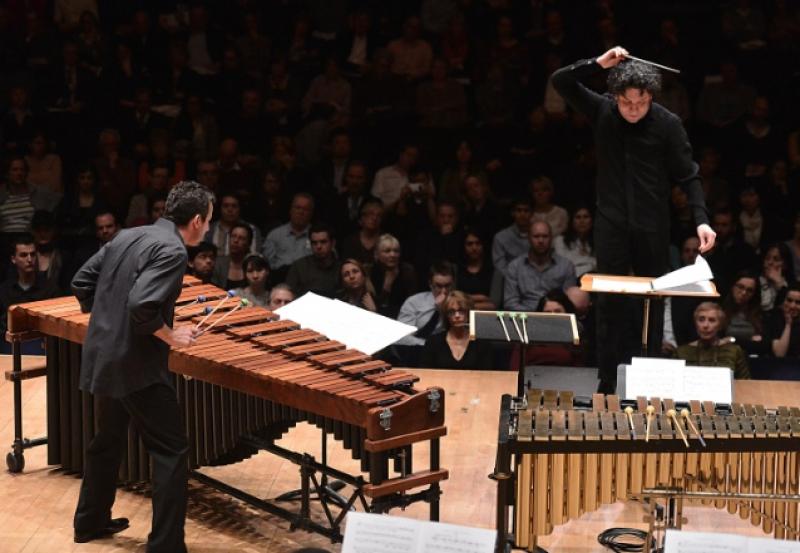
Perhaps the unfamiliarity of the first programme of the Los Angeles Philharmonic’s three night Barbican residency was too much for some – even with the world’s hottest conducting property on the podium, there were auditorium seats to spare – but in scheduling quite so much new music, the LA musicians and their music director Gustavo Dudamel demonstrated the kind of bravery few other world-class orchestras posses. This was a taste of the LA Phil’s Green Umbrella series of concerts, dedicated to new music and headed by John Adams. The orchestra’s New Music Group tackled three widely contrasting works with terrific assurance, bringing chilly London a tantalising slice of LA’s new music scene.

The programme featured music by Adams, the LA Phil principal timpanist Joseph Pereira and Korean composer Unsuk Chin. You can read my full review at Classical Source.

Wednesday, 13 March 2013

Alexander Kniazev plays Franck and Ysaye


Franck & Ysaÿe: Music for Cello and Piano
Alexander Kniazev (cello)
Plamena Mangova (piano)

Fuga Libera FUG587


The notes for Alexander Kniazev’s disc of borrowed music open with an incomprehensible justification for the practice of transcription. In truth, no argument is necessary: if these musicians wish to take music written for violin and play it on the cello, they are welcome. In practice, some transfer better than others, as demonstrated by this recital.


Kniazev is far from the first cellist to play César Franck’s evergreen Violin Sonata and, as a transcription, it works well. The long lyrical lines of the Sonata, composed for the young Eugène Ysaÿe in 1886, are rendered well on Kniazev’s instrument and there isn’t too much rapid fingerwork to get caught up in. Kniazev’s performance slows the opening Allegretto to a grandiose showcase of his remarkable sound, a torrent of extraordinarily rich legato tone redolent of the Oistrakh and Rostropovich. It really is something to behold - whenever the Sonata obliges, Kniazev opens the taps and that sound comes out. It results, however, in a monolithic performance, basking in the glory of these edifices but revealing disappointingly little of the music’s drama and narrative. Pianist Plamena Mangova often has to make do with unsympathetic tempos which disrupt the flow of Franck’s keyboard writing.

Franck’s song Nocturne of 1884 is successful without the words, but two pieces by Ysaÿe reveal the more problematic aspect of transcription. Both the Berceuse and the Poème élégiaque were composed for violin and orchestra, though both are more commonly encountered in versions for violin and piano. Ysaÿe’s often virtuosic writing pulls Kniazev away from his comfort zone and, in all honesty, the transcriptions sound uncomfortable. In addition, Ysaÿe music was often specifically composed around the possibilities of his own instrument. A funereal episode in the Poème élégiaque is a case in point: Ysaÿe asks the violin to detune the bottom string by a whole tone, producing an unexpected and unusually deep sound. This section lies well within the reach of the cello, and the effect is lost.

The disc is very clearly recorded, somewhat to the detriment of the impressionistic Berceuse. While I’ve no problem with musicians looking further afield for repertoire, I really wonder why Kniazev and Mangova chose to record two of Ysaÿe’s violin works, when both his Sérénade and Méditation for cello and piano have (to the best of a my knowledge) never been recorded. Then there’s a darkly intense Sonata for Solo Cello, which Kniazev might have excelled in. Maybe next time?

Wednesday, 6 March 2013

Steve Reich's Radio Rewrite

Steve Reich
Few contemporary composers draw the kind of crowds that Steve Reich does, and his appearance with the London Sinfonietta yesterday at London’s Royal Festival Hall had been sold-out months ago. Tickets were so scarce that press comps couldn’t eventually be offered to those towards the bottom of the food chain (i.e. me), but the disappointment was quelled by Radio 3’s live broadcast, fronted by a clearly-excited Andrew MacGregor.

It began (as Reich concerts often do) with the composer’s 1972 piece Clapping Music, intended as a demonstration of music without conventional instruments. Reich took one of the two parts for last night’s performance of this early example of his ‘phase’ pieces. Another classic followed, with Mats Bergström dusting off Reich 1987 work Electric Counterpoint, originally written for jazz guitarist Pat Metheny and consisting of overlaid tracks and a final part played live. In performance, I’ve found it an odd spectacle – one live musician playing one of twelve parts, seeming a little karaoke – but it works well on the radio, where the whole blends seamlessly with no visual distractions. It remains one of Reich’s loveliest creations.

A clutch of more recent pieces formed the bulk of the programme. 2x5 (2008) makes use of instruments more often associated with rock music – electric guitars, basses, drum kit – and marks a departure from Reich’s more conventional instrumental palette. It chugs along in typically Reichian fashion, but the twang of the guitars lends an unexpectedly homemade feel that becomes quite endearing. The headline work of the night was the premiere performance of Radio Rewrite, based in part of two songs by Radiohead (“Jigsaw Falling into Place” and “Everything in its Right Place”). The songs are barely recognisable, having been subsumed into Reich’s familiar language, but something of Radiohead’s distinctive harmony has clearly rubbed off, particularly in the slower sections. Finally, his Pulitzer Prize-winning Double Sextet (2007) demonstrated his work for an unusually large combination of instruments, but couldn’t quell the feeling that too much of Reich’s music is cut from the same cloth.